
Feuerbach's World
Science fiction short story

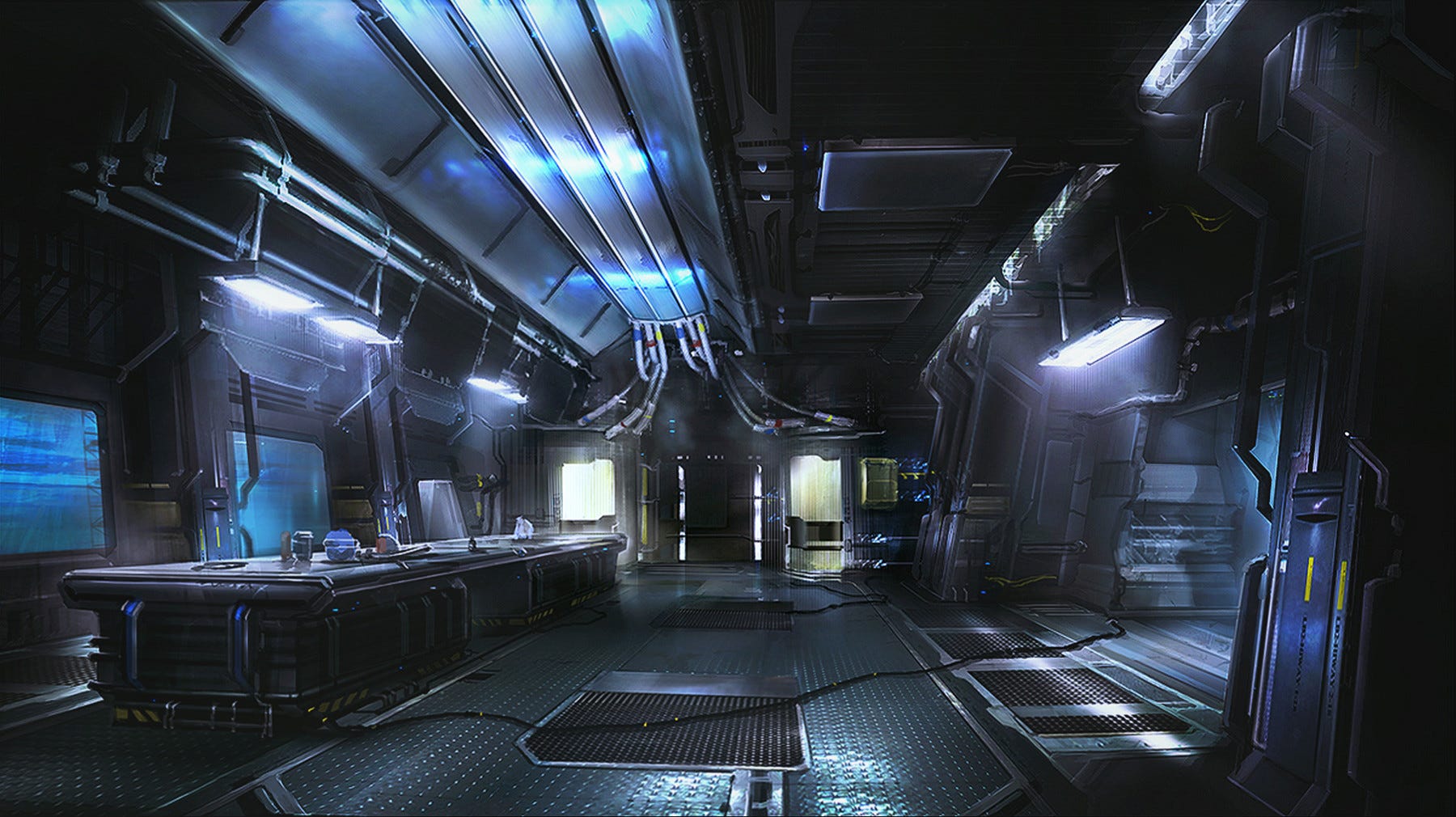
There was a terrible frustration in dying slowly.
Marek was sitting on the hilltop, watching the distant sunset, and felt his thoughts churning in a way that was part resignation, part morbid fascination. He could see for kilometres around him, the green and orange hills of the world stretching off into the distance in buckling waves on all four sides, and the shimmer of the setting sun was casting golden-red veils across it all. The heat of the day lingered, thin and dry, and the air - now that he had his mask off - smelled of something peppery, something from the local vegetation. The smell of smoke, which he had been expecting after the crash, was surprising in its absence.
He did not want to be on that hilltop, and yet he knew exactly why he was there. His thoughts were picking over the events of the past few months, examining and interrogating them over and over, looking for some new clue, some new insight… and yet he knew, in his heart, that there was nothing more to consider.
There was no hidden secret. No fact that had been missed. No piece of context that would change everything.
All of the facts were right there.
All of the bad decisions too.
Every knot in the cord, leading right to that moment on the hilltop.
Vivian was flat on his back to his left, limbs spreadeagled and mask tossed to the side. His augmented power suit was flaking bits of green from their last encounter with the khiff, and the faint steam lines rising from around his boots had turned into thin smoke lines not too long ago. As fire-resistant as the local vegetation was, even it would start charring after enough exposure to the suit’s energy fields.
To Marek’s right was the backpack they had hauled along from the crash, with its cases full of vials. The crash had not been kind to the pack, and a part of Marek was secretly terrified that the contents had been wrecked by their sudden stop after the fall.
He did not want to check either, for fear of the answer.
Schrödinger’s vials, the little voice in his head whispered, and laughed and laughed to itself.
“How long do we have?” Vivian’s voice was hoarse. They had been running for hours before finally collapsing on the hilltop.
“I dunno. Maybe an hour?” Marek looked at the shapes crawling on the horizon beneath the setting sun, then twisted to look at the northern horizon. It too was wriggling. “Probably less.”
Behind them, kilometres to the east, the smoke from the crash site was a black finger climbing into the sky to scratch at the indigo darkness overhead. The world was poor in water, and even the daytime sky was dark for most of the hours of the day. It was a twilight world, the poets from Endurance’s Hope had said, and Marek had read the article years ago and snorted to himself, and almost - almost - forgotten about it.
Twilight world.
A world where things came to an end.
Marek had read about elephant graveyards once, too, something that apparently happened on Terra Primitiva thousands of years ago. Places where the great animals went to die, when they knew their ends were near. Something instinctual in them guided them on this last journey, and their bones would collect - over years and generations - in this one place where life and light ended. Those who discovered these elephant graveyards spoke of veritable mountains of bones, of gleaming tusks picked clean by scavengers and bleached by the sun, and of a dryness in the air, almost thick enough to touch, that hinted at the lives that had come there and faded away one after the other.
Marek looked at his own aug suit shell, and the streaks of blue and white paint left on the legs, and wondered what he would look like in a hundred years.
Twilight world.
The khiff had been innocent, dumb creatures at first. The Paulsen & Feynman teams discovered them by accident, while drilling along the Ibadan plateau, and the hives had been small back then. A few thousand of them together, blind and searching in the light, their mandibles clacking as they tried to latch on to gloves and boots. Small, pale, and starved of sunlight, they had been a curiosity for the science and mining teams, and little thought had been given to what they could possibly represent.
Some went back to the labs as specimens. Others went back to the colony as pets. They were cute, in that ugly sort of way that appealed to tasteless people. They also did not require licenses initially, which made them more attractive than imported cats.
They multiplied rapidly, as dumb things tend to do. Life with the humans was soft, after all.
Then the scientists discovered that they could be trained for excavation, and suddenly everyone was growing hives and treating them with pheromones to control them. A labour force that replenished itself, consumed minimal resources, and effectively lived off the land was a dream tool at a time when labour was scarce and expensive.
The first death was a toddler that had wandered into the big labs in the science district. Her parents worked at the same lab, while the creche sat right next door; they left a door open on the creche side, someone left a door open on the lab side, and the next morning was a newsflash about the toddler’s body, mostly eaten and partially dissolved by acid, being discovered by a cleaning team.
The parents were hysterical. The lab went into damage-control mode - there were patents involved, after all, and countless billions in licensing deals - and the matter was buried.
Until the next death, and the next, and the next.
The hives grew smarter, and the scientists grew smarter at controlling them. Excavations turned into construction, and construction turned into assembly lines. Hives with corporate colours bred into their carapaces sprouted all over, with one hive feeding material into the next, until a finished product rolled out at the end. The scientists beamed, and called it green engineering at its finest. The stakeholders smiled and called it sustainable and scalable. Labour costs per unit were low enough to be negligible, and as long as there was enough of the native flora for the khiff to feed on, they did not want for anything.
Everyone benefitted, or so the story went.
The accidental human deaths kept piling up too, until the killings in Astro Ridge where it finally became too difficult to ignore what the fringe theorists had been screaming all along.
The human killings were not accidental.
The colonists were being targeted.
“Any news from the other teams?” Vivian pushed himself up on his elbows, and looked out over his boots towards the distant sun. The dent in the side of his helmet, right where the communication cluster sat, was a shadowed dimple that had left him cut off from the comms net ever since the crash. “Tell me someone else got out.”
Marek, on his rock, just shook his head. The airwaves had been quiet after the fireball and the jarring impact of the shuttle hitting the ground, and only the background hum on the electromagnetic spectrum now showed any indication of life.
That hum was the khiff swarms communicating as they closed in.
“It’s just you and me now, old friend.” Marek twisted sideways to look to the south, and spotted the khiff cresting a hill that was probably no more than two kilometres distant. “You, me, and all of the bad decisions we got stuck with.”
“Not my bad decisions, for the record.” Vivian patted the shrub-grass around him until he found the disruptor he had dropped earlier. The weapon was scorched and stained from the thousands of voltaic discharges the past few days, and half the muzzle prongs were bent after the crash. Marek’s own disruptor looked little better. “I was against this shit right from the start. I told them, with every meeting, exactly how I felt, but did they listen?”
“Money doesn’t listen to people like us, you know that.” Marek racked the cycler on his own disruptor, throwing a practiced glance over the silicone-smeared internals, before lowering the weapon again. “Money listens to money. That’s it. People like you and me don’t shift the dials in that world.”
“Star-worshipping parasites.” Vivian spat to the side, face twisted in disgust. “Sitting fat and safe in orbit now, counting their money and insurance payments, while we get sent the bill down here. Not even the khiff do this to their own kind.”
“You know what they’re waiting for.” Marek searched through the shrub-grass next to him until he found a thick stem, plucking it a moment later and popping it into his mouth. The sap was a bitter burn along the side of his tongue, and brought back memories, as it always did, of his first tour on this world. The vast, pristine landscapes where no human had walked before. The forests and the lakes. The picturesque settlements of the colonists. The prairies of Fulda State, before the prospectors and the hives arrived.
Twilight world.
It would be his last tour now, it seemed.
“They’re waiting for the next lunar superbloom, when all the critters go to sleep for three days. Then they’ll come down with the sprayer drones, drown everything in chemicals, and get the swarm leaders back under control. After that, the queens will fall back in line too.” Marek rolled the grass stem over to the other side of his mouth, feeling the slight numbness that it left behind where the juice had leaked out of the crushed stem. “There will be press releases about how unfortunate it is that there were casualties, and all the flapping mouths will make sounds about changes and new safety precautions, and in the end…”
Marek trailed off, and Vivian, at his side, just sighed.
“Yeah. In the end, we’re all dead, and they’re still in business.”
“We can change that, though.” Marek looked at the backpack next to him. “This time we can change it.”
Schrödinger’s vials beckoned, and Marek decided to take the plunge. The backpack opened easily enough under his hands, and the first case he pulled out - silvery red, with the lab logos from Endurance’s Hope etched on the sides - came apart when he tried to open the latches. Gummy drools of bio-liquids dripped from the seams, turgid and grey, and Marek tossed it away without even continuing.
“So much for that crash-resistant padding crap they always told us about,” Vivian muttered from the side, and watched as the grey sludge slowly sank away into the surrounding shrub-grass. Marek just shook his head and reached for the backpack again.
The second case was still intact, but opening it showed cracked vials and thick, caked excretions where the liquids had come into contact with the air and begun their transformation. Hormone accelerants, packaged to be administered via aerosol gun to the various khiff messengers, now formed tacky clumps inside the case. Designed to bond with the khiff carapaces and deliver a long-lasting pheromone programme to the creatures, the liquids had cost billions to develop, and had been one of the least stable parts of the entire operation.
Gregori had been the only survivor from the lab strike, and Marek still did not know how many people had died to get that backpack out of the science district. Konstantin had passed them the pack at the last moment before they boarded the shuttle, and after that their story had been lost. Konstantin was a dark figure in Marek’s memory, now, surrounded by flailing blue lightning from his disruptor as the khiff swarms flooded onto the landing pads below them.
Eventually, even the lightning had to cease - and darkness had reigned.
The third case held two intact vials, and Marek found his hands shaking when he pried them out of their padding. The liquids inside were oily, and gleamed with the same iridescence that glimmered in the multi-faceted khiff eyes.
These were not the usual pheromone programmes, though.
These were the programmes that had been reserved and locked away for emergencies, and which people like Gregori and Konstantin and who knows how many others had died for to get their hands on. The programmes that no-one had even known about until the leaks from the science division showed up after the Astro Ridge massacre. Marek suspected there was someone in orbit who had felt sorry for them, but there had never been any proof. Whoever it was, was probably too smart to take risks like that.
The vials just needed one last ingredient now to be activated.
“One each. We can make this work.” Marek passed one vial to Vivian, then tugged the injector out of the case as well. His vial slotted into the back of the little device without issue, and it lit up a string of green indicators to show that it was ready.
“Are you ready for this?” Marek indicated the approaching wave of khiff that surrounded them. The entire horizon was writhing now, a noose drawing tighter and tighter. “Once we inject these, our time is up. Our story ends here.”
Vivian levered himself up, disruptor in one hand and his vial in the other, and looked out to the west. Marek followed his gaze, and saw the sun inching its way below the horizon in slow, gradual steps.
Above it, fat dots in the rising dusk, the corporation drones hung, and watched everything. The same drones had gone after their shuttle hours before, and had circled and watched as they staggered out of the wreckage.
Just more footage for the data teams.
“Our story ended a long time ago, my friend.” Vivian’s face pulled into a smile, teeth red in the setting sunlight, and there were wet lines down his cheeks when he turned to look back at Marek. “My story ended when they took Sarah and the kids. I’m just counting the minutes now until I can see them again.”
The injector was cold and sharp against Marek’s neck, and the liquid traced an icy burn down into his chest as his heart hammered away. There was already a metallic taste in his mouth by the time he passed the injector over to Vivian, and a faint roaring began to build in his ears.
Marek stood, fighting the vertigo that sent the terrain around him spinning, and turned to face off to the south. Vivian was grimacing at his side as the injection burned into his own system, and then the other man was straightening up and holding out his hand.
“It’s not what we wanted…”
“...but it’s what needs to be done,” Marek finished, and grasped the other man’s hand one last time. “For our people.”
“For Sarah.”
“For Hope.”
They set off, one to the north and one to the south, and Marek had to shake his head several times before his eyes properly focused on the rolling shrub-grass in front of him. The khiff were close now, hundreds of metres, and his first blast from the disruptor carved out a lane of twitching, smoking bodies as the lightning tore through their tight-packed masses. Squeals and hisses rose from the heaving mass in front of him, and he pushed himself into a run, firing from the hip and aiming deeper into the swarm.
He had to get them angry.
He had to get their pheromone cloud up and boiling before he went down.
He was inside the swarm in moments, boots trampling over crackling, carbonized husks where the disruptor had lashed at them - but the khiff were endless, and they were already milling around his feet, snapping at his ankles and reaching for his knees.
The disruptor howled, warmer and heavier with every discharge, and at some point Marek felt his eyes unfocusing for the last time. The roar in his ears was drowning out everything at that point. He went down into the swarming mass, arms and legs suddenly numb inside his suit, and watched with detached curiosity as the swarming creatures tugged at his limbs and reached for his face. Mandibles sawed across his face, something pulled his one arm back in a way that he knew was supposed to hurt but did not - and then his world went dark, and the roaring in his ears rose up and crashed over him until nothing remained.
Around him, the pheromone swirl thickened as the khiff ingested this last irritant that had threatened their nests - and something inside them began to change.
Bloodied mandibles quivered and shook with rage, seeking out new targets even as their old instincts were overridden, and slowly but surely the swarm began to turn on itself.
* * * * *
The executive was reading the latest reports from the surface when the message from the lab arrived.
Breakthrough on the Theraneux hive sequence. Lab Delta-7, come see ASAP. Constance.
His frown was short, and faded as quickly as it had arrived. The surface hives had torn themselves apart during the last controlled bloom, and not even the subsequent lunar superbloom had managed to sedate the creatures. What had started out as a controlled burn to get rid of the human colonists had turned into a raging firestorm of rampaging khiff swarms. Docile hives had turned violent well past their acceptable parameters, and the monitoring drones had captured countless cases of what appeared to be secessionist splits: clusters of khiff suddenly rallying around individual khiff and promoted them to matriarch status via their pheromone dances. The old hive identities were all but gone, queens killed and worker forces depleted, and countless raging bands of the creatures now covered the surface of the colony, feeding and fighting in an endless orgy of violence against one another.
What control and infrastructure the corporations had had at one point, was long gone now. It was an unmitigated disaster, and the insurance payouts from the culled colonists paled into insignificance against the creditor claims that had rolled in despite their force majeure statements.
The supply chain wanted blood.
The orbital labs had been unaffected by the disaster though, and several proto-hives, kept there for study and development, had been quarantined at the outbreak. There, in isolation, the research teams had worked to understand what could have caused the loss of control - and the Theraneux hive was one of those.
If there was progress there, they might still be able to save something from this mess before the damned bugs ate everything.
The executive left his office and took the corridor conveyor belts deeper into the station, heading for the core where the labs and the containment areas were. The night-time bustle of the station parted around him with whispered glances and downcast eyes - the staff here knew what was at risk, and where the axe would fall if things did not improve. He ignored them all, face set and lips pursed, and ran the numbers again in his head.
If the Theraneux hive could offer a reversal…
The Delta-7 lab was one of the deeper labs, right in the middle of the containment area, and the executive encountered fewer and fewer staff as he got closer to it. The night shift was generally quieter, and whoever was working down there must have been using that solitude to focus on results.
Results.
That was what they so desperately needed.
The lab doors slid open with barely a hiss, and the executive was already several paces into the lab before he halted. The research pods and containment tanks stretched off in thick clusters around him, and the central admin area, with its clusters of screens and whiteboards, was an empty island in it all. There was no-one in sight, although the motion-sensor lights were all still on.
“Constance? Are you here? I got your message.”
Something had been scrawled across the one whiteboard in bold red lines, and the director caught a whiff of copper as he stepped closer and squinted at the drawings. It had run, oozing downwards, and it took him several moments before he could make it out.
Time to pay the price Cohen
Was that blood? The executive dabbed the edge of the one line with his finger, and felt the tacky red give a little. His own speciality was law and accounting, and what little he knew of labwork could probably not fill…
The lab doors hummed to themselves, magnetic locks engaging, and the red seal light above the doors came on. The pulse tone from the lab AI assistant sounded, and a sterile, genderless voice whispered into existence from the speakers above the door.
“Containment breach. Please wait while emergency services are notified.”
In the depths of the lab, something clattered.
The lab lights were smart. They scanned for a combination of motion and heat, to detect humans, and small heat sources - like the automated cleaning bots which deployed at the end of every shift - did not trigger them. Likewise for large, cold objects like the remote manipulator arms, which were also capable of working perfectly well in the dark.
The lights did not see the moving khiff as large enough to trigger, and so, one by one, they began to shut down, even as the khiff crept closer.
They did not see the manipulator arms as warm enough either, as they swung through pre-programmed arcs and wrestled open the rest of the khiff containment tanks.
The lone light above the door stayed on, sensing the frantic motion and rapid heat in front of it as the executive battered at the door.
In time, after the screaming and twitching had stopped, it too switched off.
Awesome, once again. Your structure creates a perfect circle of consequence, from the dirt of the hilltop to the chrome of the station. The Twilight World imagery, the peppery air, the black finger of smoke, all set a tone of terminal exhaustion. The Schrödinger ref made me smile and the "Smart" failure of the sensor lights was a masterstroke of ironically poetic justice. Intelligent, visceral, and deeply satisfying. Great stuff!